
Discover why SMS codes are no longer sufficient for MFA and which modern, secure, and phishing-resistant authentication solutions to adopt in Switzerland.
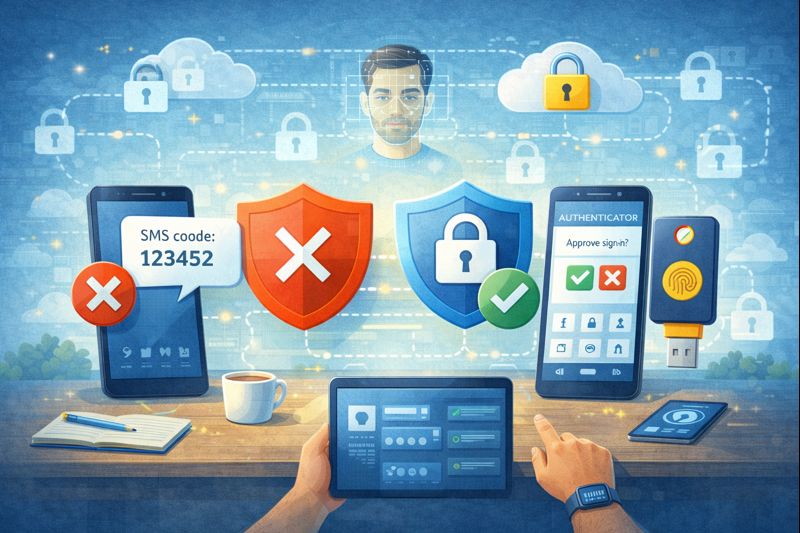
MFA Security: Why SMS Codes Are No Longer Enough in 2026 (and What to Adopt in Switzerland)
For many years, enabling multi-factor authentication (MFA) has been a cornerstone of account and device security. MFA remains essential, but the threat landscape has evolved, making some traditional methods less effective. The most common form of MFA – four- or six-digit codes sent via SMS – is convenient and familiar, and certainly an improvement over passwords alone. However, SMS relies on aging technology, and cybercriminals now have reliable techniques to bypass it. For organizations handling sensitive data, SMS-based MFA is no longer sufficient. It is time to adopt modern, phishing-resistant MFA to stay ahead of current attacks. SMS was never designed as a secure authentication channel. Its dependence on mobile networks exposes it to significant vulnerabilities, particularly within telecom protocols such as Signaling System No. 7 (SS7), which is used for communication between networks. Attackers know that many companies still rely on SMS for MFA, making it an attractive target. For example, SS7 vulnerabilities can be exploited to intercept SMS messages without even accessing your phone. Eavesdropping, message redirection, or injection can occur directly within the operator’s network or during transmission. SMS codes are also vulnerable to phishing. If a user enters their username, password, and SMS code on a fraudulent website, attackers can capture all three elements in real time and immediately access the legitimate account.
Understanding SIM Swapping Attacks
One of the most serious threats associated with SMS is SIM swapping. In this type of attack, a criminal contacts your mobile carrier while impersonating you and claims to have lost their phone. They then request that your number be transferred to a new SIM card in their possession. If successful, your phone loses service while the attacker receives all your calls and SMS messages, including MFA codes for your banking or email services. Even without knowing your password, they can reset your credentials and take full control of your accounts. This type of attack does not require advanced technical skills. It primarily relies on social engineering targeting carrier customer support, making it simple yet potentially devastating.
Why Phishing-Resistant MFA Is Becoming the New Standard
To counter these threats, it is essential to minimize human intervention by adopting phishing-resistant MFA. This approach relies on cryptographic protocols that bind each login attempt to a specific domain. One of the most widely adopted standards is FIDO2, which uses cryptographic keys tied to both a device and a domain. Even if a user clicks on a phishing link, the authentication application will not release credentials if the domain does not match. This technology is also passwordless, eliminating the risk of phishing-based theft of passwords or one-time passcodes (OTPs). Attackers are forced to target the device itself, which is far more difficult than deceiving a user.
Using Hardware Security Keys
Hardware security keys are among the most robust phishing-resistant solutions available. These are small physical devices, similar to a USB key, that are inserted into a computer or tapped against a smartphone. To log in, the user simply inserts or taps the key, which then performs a cryptographic verification with the service. This approach is extremely secure because there is no code to enter, and attackers cannot steal the key remotely. They would need to physically obtain it, which is significantly more difficult.
Authenticator Apps and Push Notifications
If physical keys are not feasible, authenticator apps such as Microsoft Authenticator or Google Authenticator are a clear improvement over SMS. Codes are generated locally on the device, eliminating the risks associated with SIM swapping or SMS interception. Push notifications do carry some risk. Attackers can send multiple approval requests, leading to MFA fatigue, where a user eventually taps “approve” simply to stop the alerts. Modern applications now integrate number matching. The user must enter in the app the number displayed on their login screen, ensuring they are physically present at their device.
Passkeys: The Future of Authentication
As passwords are regularly compromised, modern systems are adopting passkeys – credentials stored on the device and protected by biometrics such as fingerprint or facial recognition. Passkeys are phishing-resistant and can be synchronized through services like iCloud Keychain or Google Password Manager. They offer the security of a hardware key with the convenience of a device the user already owns. They also reduce the burden on IT teams, as there are no passwords to store or reset.
Finding the Balance Between Security and User Experience
Moving away from SMS-based MFA requires a cultural shift. Because users are accustomed to the simplicity of SMS, introducing hardware keys or authenticator apps may initially meet resistance. It is crucial to explain the reasons for the change, particularly the risks of SIM swapping and the value of the data being protected. When users understand the stakes, they are more likely to embrace stronger measures. A phased rollout can help for general internal users, but phishing-resistant MFA should be mandatory for privileged accounts – administrators, executives, and leadership.
The Cost of Inaction
Continuing to rely on outdated MFA methods creates a false sense of security. Even if such methods satisfy certain compliance requirements, they leave systems exposed to costly attacks and breaches, both financially and reputationally. Modernizing authentication methods offers one of the strongest returns on investment in cybersecurity. The cost of hardware keys or identity management solutions remains modest compared to the expenses associated with a security incident, incident response, or data recovery.
Is Your Company Ready to Move Beyond Passwords and SMS Codes?
We specialize in deploying modern identity solutions that are secure and easy to use. Contact us to implement a robust authentication strategy tailored to your organization.