
Secure guest Wi-Fi: adopt Zero Trust in French-speaking Switzerland
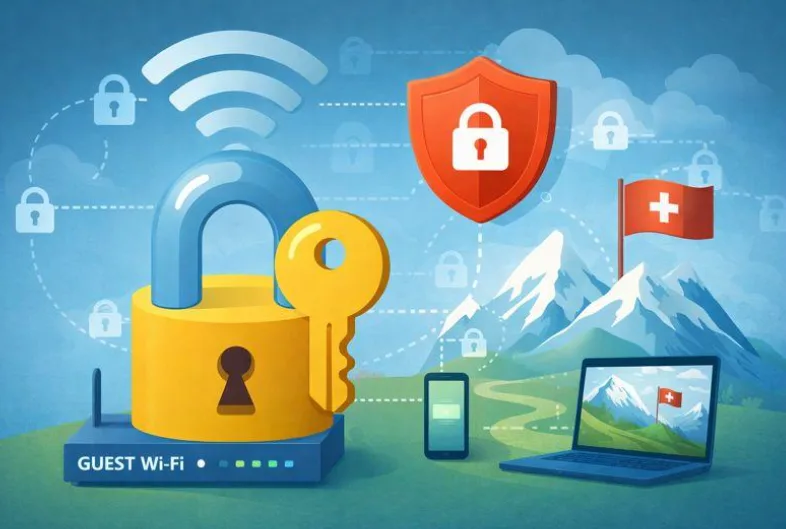
The fundamental principle of Zero Trust: never trust, always verify
No device or user should be granted automatic trust simply because they are connected to your guest network. Below are the key steps to creating a secure and professional guest Wi-Fi environment.
The business benefits of a Zero Trust guest Wi-Fi
Implementing a Zero Trust–based guest network is not just a technical necessity—it’s a strategic decision that delivers financial and reputational benefits.
By moving away from the risky shared-password model, you significantly reduce the likelihood of costly incidents for your business in French-speaking Switzerland and beyond. A compromised guest device could otherwise act as a gateway for attacks, leading to service disruptions, data breaches, or regulatory fines.
Conversely, proactive measures such as isolation, verification, and strict policy enforcement are an investment in business continuity and peace of mind.
Real-world example: the well-known Marriott data breach, where attackers exploited a third-party access point to compromise millions of personal records. While not strictly a Wi-Fi incident, it illustrates the financial and reputational consequences of a network vulnerability. A Zero Trust guest network that strictly isolates guest traffic from internal systems would have prevented this type of lateral movement.
Building a fully isolated guest network
For SMEs in French-speaking Switzerland, we recommend complete network separation as the first step. Your guest network should never mix with internal traffic.
How to do it:
Create a dedicated VLAN for guests with a separate IP range.
Configure your firewall to block all communication between the guest VLAN and the main VLAN.
Guests should only have access to the Internet. This strategic isolation prevents any infected device from spreading to your servers or sensitive data.
Deploying a professional captive portal
Forget the static password. Replace it with a secure, customized captive portal (like those used in hotels or conferences).
Possible options:
A unique code generated by reception, expiring after 8 or 24 hours.
A form requesting name and email address to trace connections.
One-time password (OTP) authentication sent via SMS.
These methods enforce the “never trust” principle by turning an anonymous connection into an identified session.
Strengthening security with NAC (Network Access Control)
A captive portal is a good start, but for optimal security, add a NAC solution.
NAC acts like a digital bouncer, verifying the identity and compliance of each device before granting access.
Examples of checks:
Firewall enabled on the device.
Latest security updates installed.
If a device fails these checks, NAC can redirect it to a restricted zone with instructions or block the connection entirely.
Limiting session duration and bandwidth
Zero Trust is not only about access, but also about duration and usage.
Enforce timeouts (e.g., reauthentication every 12 hours).
Limit bandwidth to prevent 4K streaming or massive downloads.
These measures reduce exposure without disrupting essential needs such as email and web browsing.
Creating a secure and welcoming experience
Zero Trust guest Wi-Fi is no longer reserved for large enterprises—it is a fundamental requirement for all organizations, including SMEs in French-speaking Switzerland.
By adopting a layered approach—segmentation, verification, continuous enforcement—you eliminate a commonly overlooked entry point while delivering a professional service to your visitors.
Need secure guest Wi-Fi without complexity?
Contact AWSMTECH (Switzerland) LTD today. We help companies in French-speaking Switzerland and across the country implement these best practices easily, ensuring your peace of mind and the security of your guests.