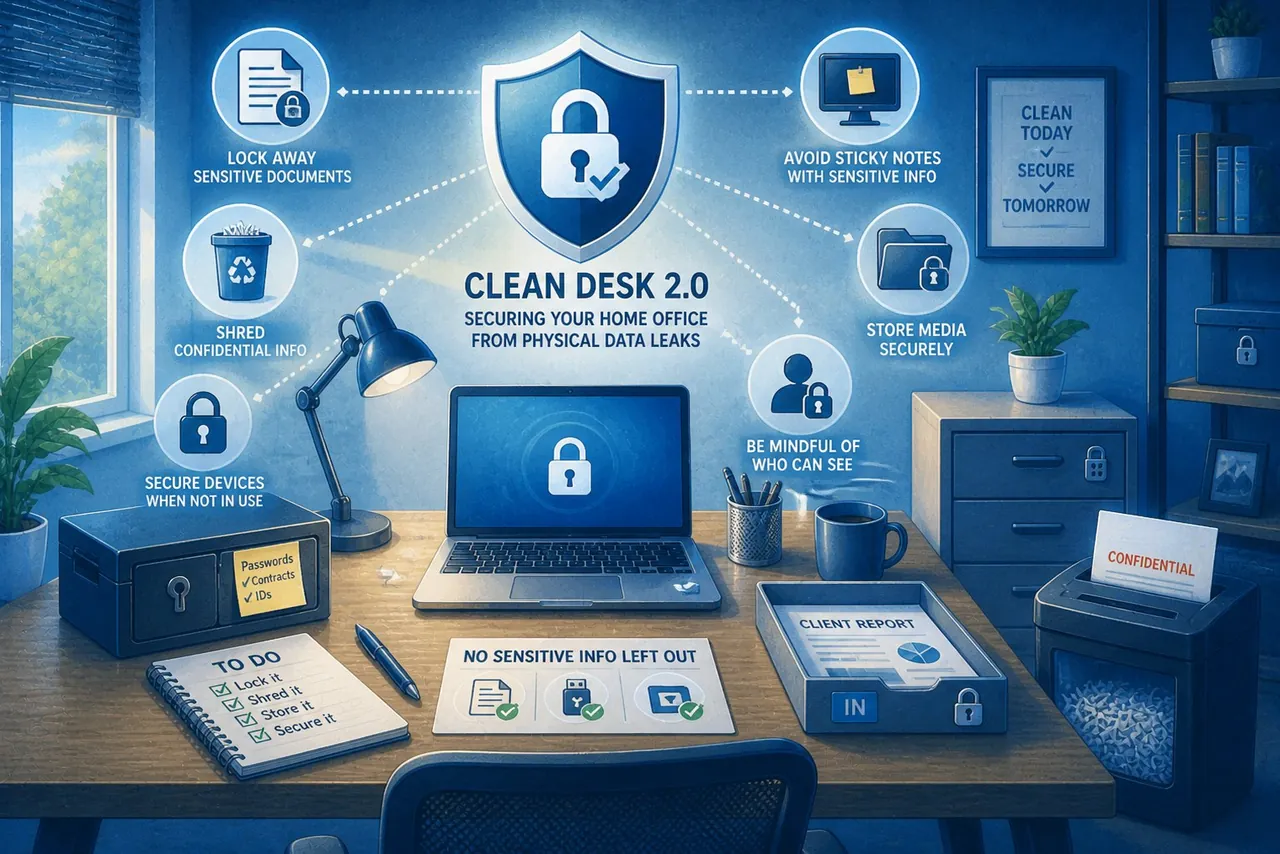
In the traditional office, a Clean Desk policy relied on simple discipline: shred sensitive documents, lock them away and never leave passwords visible.
At AWSMTECH (Switzerland) LTD, we often remind our clients in Geneva that the principle hasn't changed, but the environment has evolved.
In 2026, the "desk" is no longer just a physical surface.
For many teams in French-speaking Switzerland, remote work has become the default workspace. This means physical access can very quickly become digital access. An unlocked screen, a shared device or a laptop left in the wrong place can expose the same critical systems your organisation relies on every day.
Clean Desk 2.0 is not about appearances. It's about securing the bridge between physical and digital.
If a guest, a delivery person or even a passer-by can sit down at your workstation, they don't need advanced technical skills to cause damage. A few unsupervised minutes and an open session can be enough.
01Why an unlocked screen can become a data leak
Most small business leaders view multi-factor authentication as the ultimate protection. It is indeed an important measure. But as we regularly explain to small businesses in Geneva, once you're already logged in, multi-factor authentication is no longer the control that protects you.
When you log in to a cloud application, your browser creates a session token, often stored as a cookie, so that you don't have to authenticate for every action. Cybersecurity vendors such as Kaspersky describe session hijacking as "cookie hijacking," while Proofpoint compares session tokens to digital keys. If these keys are stolen, attackers can impersonate users and bypass controls such as multi-factor authentication.
This is where physical access changes everything.
If someone can sit at your desk while you step out for coffee, they don't need to crack your passwords. They can reuse your already-authenticated session and access the same cloud platforms, CRM data and financial tools you were using moments earlier, without triggering an additional authentication request.
This is why, at AWSMTECH (Switzerland) LTD, we insist that Clean Desk 2.0 must include a genuine auto-lock culture:
- Use short screen-lock timeouts
- Manually lock your screen every time you step away
- Treat an open session as a set of keys left in the door
02The technology debt visible on your desk
Most people keep old equipment for a simple reason: it still works. But "still works" does not mean "still secure."
The same technology debt we observe in server rooms also exists in home offices in Geneva, often in the most sensitive places: routers, VPN gateways, Wi-Fi access points, or the "backup" laptop that hasn't been updated in months.
The critical issue is end of support. Once a device reaches end of support, security updates stop. Official recommendations are clear: once a product becomes obsolete, the only fully effective measure is to stop using it. It is impossible to durably patch a device that no longer receives fixes.
This is particularly dangerous for internet-facing equipment, meaning anything sitting between your home network and the outside world.
One key Clean Desk 2.0 habit we recommend to businesses in French-speaking Switzerland is to audit home office equipment like a server room:
- Identify all internet-facing devices
- Check that they are still supported and regularly updated
- Remove or replace anything that is not
03Your digital employee needs a locked door
As AI becomes embedded in everyday business tools, workstations are no longer just where work gets done. They also become where automated actions get executed.
An AI agent can update your CRM, draft client communications, schedule appointments or advance processes with minimal human intervention once launched. For SMEs in Geneva, this brings efficiency, but also a new physical risk.
Unattended sessions and automation don't mix well.
If an AI-driven process is running while you're away from your desk, an unlocked screen effectively becomes an open control panel. You don't need to be a technician to interfere. A few clicks can approve an action, redirect a payment, alter data or disrupt an active workflow.
The solution is not to avoid automation. At AWSMTECH (Switzerland) LTD, we recommend treating AI-driven processes like any other powerful business system: with clear boundaries and validations.
Define in advance:
- Which decisions an AI agent can make without human presence
- Which actions require explicit approval
- Spending limits and escalation rules
- Which systems and data the agent can access, and which are off-limits
04Physical efficiency and cloud waste
The Clean Desk 2.0 approach is not only about security. It's also about operational discipline: knowing what you use, why you use it, and what should be turned off when it's no longer needed.
Cloud waste is the digital equivalent of lights left on in an empty building. Among SMEs based in Geneva, it often takes the form of underused servers, forgotten test environments or storage volumes that keep growing without active management.
Nothing seems dramatic on a day-to-day basis. Costs simply rise, quietly, month after month.
The habit that fixes this is the same one that keeps a physical space under control: visibility and accountability.
Assign owners to environments and key cloud resources, check what is actually being used, and plan to shut down non-productive workloads outside office hours. These regular "tidying up" practices reduce costs, limit exposure and make your environment much easier to manage when an incident occurs.
05Building a Clean Desk 2.0 foundation
Securing a home office against physical data leaks is not about paranoia. It's about professionalism. In 2026, the home workspace is no longer secondary. It's part of your company's perimeter.
Clean Desk 2.0 relies on modern standards: locked screens, supported devices, clear responsibilities and secure automation. When these foundations are applied consistently, small home-office oversights stop turning into larger business incidents.
At AWSMTECH (Switzerland) LTD, we help small and medium-sized businesses across Geneva and French-speaking Switzerland turn these principles into simple, actionable standards.
If you'd like to implement Clean Desk 2.0 across your team, contact us for a technology consultation.
Need IT support?
AWSMTECH (Switzerland) LTD supports SMEs in Geneva and French-speaking Switzerland with pragmatic, risk-oriented audits.
Contact us